


We’ve entered the reality TV phase of startups.
Around 2000, reality TV as a format exploded. It’d already existed for years by then, so some of you might remember The Real World and Road Rules in the ‘90s. Then Who Wants to Marry a Multi-Millionaire? aired and became a tabloid disaster. Several months later Survivor premiered and crushed TV ratings. Then suddenly every network exec learned the same hack: regular people were cheaper than hiring stars, attention-seekers were great in front of the camera, and mixing the right blend of personalities and storylines kept audiences watching.
In a growing corner of startup land, I’ve noticed some founders behaving like lead characters of their companies. And employees are becoming supporting cast members. Company milestones have become episodes. Office life has become content: techie-on-techie drama, launch events, employee backstories, “a day in the life”, memes, and even ragebait. And some product launches are practically short films now, like Lemma’s recent Obsession-inspired ad.
This isn’t happening everywhere. No, most startups still seem pretty unexciting. The pattern I’m seeing frequently pops up in the online corner of startup culture where founders, customers, employees, investors and reporters are all hanging out in many of the same feeds.
That overlap is fascinating. Someone watching your company video might be a potential customer. Or a mission-driven operator deciding where to work next. Perhaps a podcaster looking for a guest. Or a VC deciding which companies matter.
In that environment, attention can do more than just generate leads. It can make a company feel bigger, sexier, faster-moving, and more inevitable than it did yesterday.
You’re no longer just using a product. You’re tuning into the company.
This isn’t a new tactic. I’m old enough to remember Cal Worthington starring in his own car dealership commercials alongside his “dog Spot,” who I later learned wasn’t even a dog. Spot was cast as everything from a chimp to a tiger to an elephant, and this happened decades before anyone had ever dreamt of social media. (I promise I’m not THAT old.) The difference is that Cal needed TV airtime to reach audiences. Today almost everyone carries a mini broadcast network in their pocket.
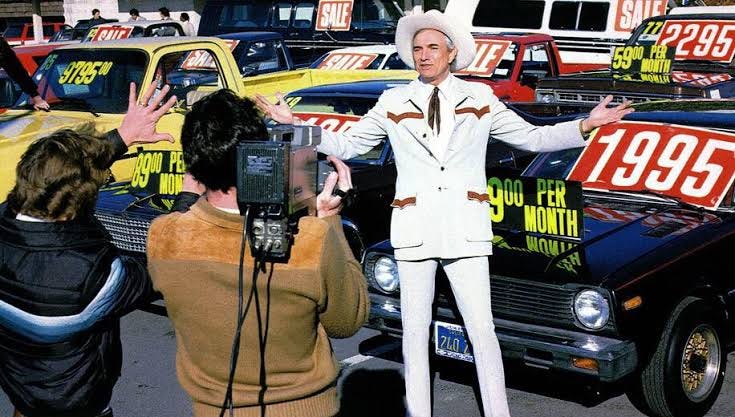
Pooh-poohing this as a passing fad misses the point of what’s actually happening: the company itself is becoming a distribution channel, and it airs wherever it wants. The product is still the product. But more and more I’m seeing a second product emerge: the show around the company.
Corgi: The ensemble cast
Corgi, a YC-backed insurance startup, had for the better part of this year what tech Twitter dubbed the “Corgi girls”: a squad of employees whose individual personalities, posts, and daily lives became part of the company’s distribution.
The Corgi girls are why much of the feed noticed the insurance company in the first place. Attractive and perpetually online, they posted about everything: work, personal stories, day in the life content, career aspirations, corgis... Every reality TV producer since The Real World has known that a camera-ready cast is essential, and Corgi certainly has one.
I imagine that Corgi stumbled onto something that worked and leaned into it. These employees play host to the world that Corgi has been creating around its insurance company. The viewer tunes into whatever is happening at the moment: the cafe, co-working sessions, the shuttle bus offering free rides, startup-sponsored drinks, founder dinners, a newspaper, and even some drama.
The San Francisco Standard covered the August opening of the Corgi cafe in the Dogpatch and reported that several people at the launch party weren’t there for the insurance. One attendee didn’t even know Corgi sold insurance in the first place.9
The real story is the company itself. Corgi became known for its seven-day workweek. It was previously reported that there were mattresses in conference rooms because employees, including CEO Nico Laqua, sometimes slept at the office1. The employees even collectively own a corgi named Trudy, whose care is coordinated through an AI bot that reminds employees when she needs attention. As a corgi owner myself, I know that it takes a village (and technology) to raise these adorable yet high-maintenance beasts.
Then there’s the money. Like, a fuck ton of it. In early May, Corgi announced a $160 million funding round that valued the company at $1.3 billion1. Three weeks later, it raised another $106 million and doubled that valuation to $2.6 billion3. Then in July, according to Forbes, the company closed another round at a $4 billion valuation2, though the amount raised wasn’t disclosed. And as an encore in late September, it raised $64 million at a $5 billion valuation10. This is the kind of fundraising that would make Adam Neumann blush. When TechCrunch asked investor Kanyi Maqubela what justified skyrocketing the valuation in just three weeks, he cited momentum.3
Back in May, Forbes reported that Corgi claimed approximately $100 million in annualized revenue1. Maqubela also stated that investors don’t always take these sudden jumps in startup valuations at face value. And he argued that Corgi’s revenue growth justified that particular round3. Maybe he’s right. But I still wonder if the expectations created by all of this momentum might eventually bite Corgi in the butt.
Reality TV doesn’t work because everyone is attractive and the house is big. It works because there are real stakes involved. People will be sent home. Someone unexpected might win the grand prize. Or Pumpkin spits in New York’s face on Flavor of Love. The real reason to tune in is to watch how the season unfolds.
Oh, and somewhere in there Corgi also sells insurance.
Cluely: The protagonist
Corgi has an ensemble cast. Cluely has Roy Lee.
Roy established himself as Cluely’s main character. His controversial takes, interviews, stunts and arguments are part of the show. People tune in not only to see what Cluely ships, but to see what Roy does next.
Cluely burst onto the scene with a launch video depicting Roy using the product on a date with a woman12. Equal parts comedy sketch and Black Mirror episode, we see Roy use the tool to lie about everything from his age and career to his appreciation for her art. The whole thing could have easily been a Loom recording of Roy narrating how to use the product. Instead, the product was pitched as “cheat on anything,”4 which was provocative enough to get a lot of people, whether they loved or hated the idea, to stop scrolling and pay attention.
A few months later on X, Roy promoted what he proclaimed to be “YC’s AI Startup School after-party.” What started as an invite-only fiesta went viral. Around 2,000 people supposedly tried to get in before SF police shut it down5. Naturally, the shutdown became part of company lore. You can’t write this stuff.

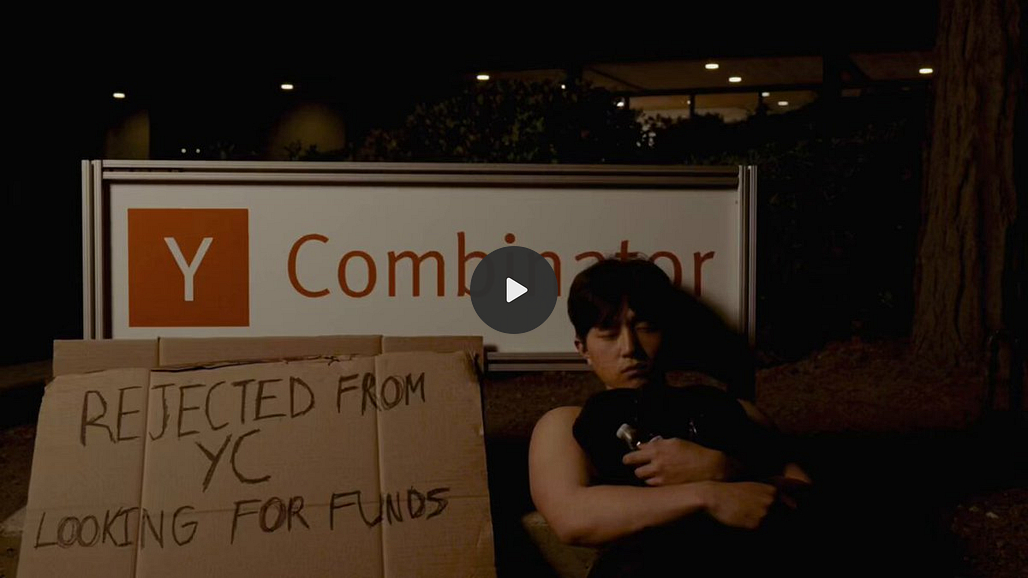
That’s different from hiring a celebrity spokesperson or buying a billboard along the 101. Now, anyone with a little reach and a strategy can stir up controversy as part of distribution. Roy understands that if people are talking about him, they’re also talking about Cluely.
Though sometimes the line between the character and the company gets... blurred. In March, Roy publicly admitted that the $7 million ARR figure6 that he’d previously quoted to TechCrunch was false7. Roy described the interview as an unexpected cold call from a reporter asking about revenue, and said that he hadn’t expected the conversation to produce an article. According to TechCrunch, however, Cluely’s own PR person arranged the interview, gave the reporter Roy’s number, and confirmed that he was expecting the call7.
At that point, “main character” starts looking less like a marketing strategy and more like a liability. When a founder is the entertainer, salesperson, and company spokesperson, the performance and the business story can bleed into one another and erode trust.
The instinct behind all of this isn’t new. Richard Branson spent decades as the Virgin Group’s main attraction: hot air balloon record attempts, riding a tank through Times Square to launch Virgin Cola, or showing up in a wedding dress to launch Virgin Brides. Both of those businesses would fail, by the way. Growing up, I admired the rockstar nature of Branson’s marketing. Virgin was usually the upstart amongst legacy players, and Branson used a rebellious image to make the old guard look, well, old. I couldn’t have told you anything about Virgin Atlantic’s routes or fares. But I tuned in for Richard.
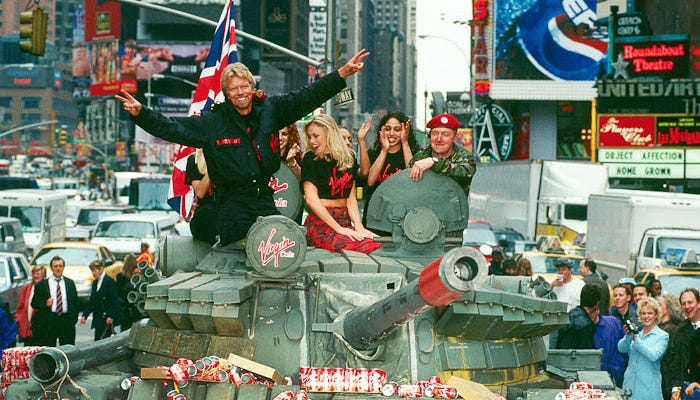
Branson used spectacle to inject rebellious personality into traditional businesses. With Cluely, it feels like spectacle is the distribution engine itself.
So why now?
Attention is expensive.
Everyone is fighting for reach in the same feeds. Your company isn’t just competing with other companies. It’s competing with creators, meme accounts, breaking news, ragebait, sports clips, movie trailers, and whatever lifestyle creator decided to schedule a car seat confessional that day.
Building a useful tool by itself doesn’t guarantee anyone will notice. A company must now earn that attention over and over again. It’s why I watch SpaceX launches with my 3-year-old. Picture a skyscraper-sized rocket blasting into space on a broadcast-quality livestream with multiple camera angles, then see a Super Heavy booster return to Earth and get caught in midair by a tower with chopstick arms. It’s not only a technological marvel, it’s damn good entertainment.
That’s the competition.
Production is cheap enough.
A startup can shoot, edit and distribute something globally without legacy broadcast infrastructure or gatekeeping. The big shift here isn’t just that production got cheaper, distribution did too. A founder doesn’t need a TV station, magazine, or a friendly journalist to reach an audience.
Getting onto the feed is cheap. The challenge is convincing viewers to care.
People are more likely to follow people than corporate accounts.
Nobody wakes up excited to follow a corporate account like @EnterpriseSaaSPlatform. People might prefer to follow a colorful founder, a hilarious salesperson, or an eccentric engineer.
Some employees are becoming both characters and distribution channels.
And some companies are starting to operationalize all of this.
AIOS, another YC-backed company, recently listed a Head of Viral Social role whose job includes, and I’m not making this up, helping “engineer attention at scale.” Startups are now explicitly hiring people to manufacture virality, manage UGC creators, coordinate clippers and produce short-form videos at scale.
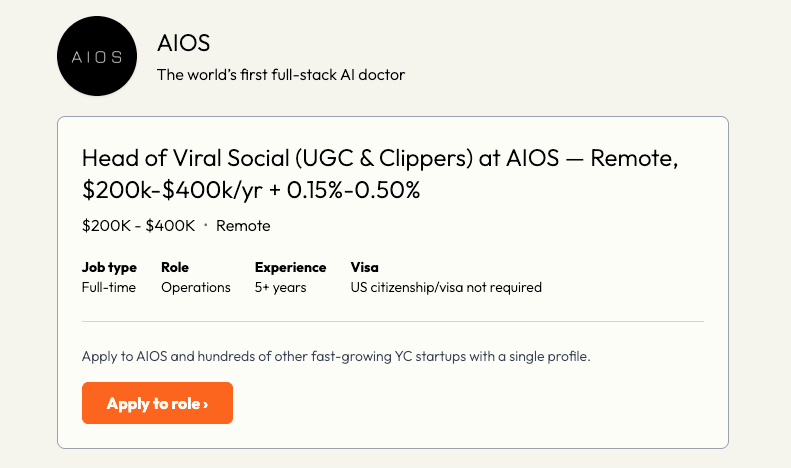
So how do we value attention in this new world? One piece of content can potentially recruit, sell, generate press, build status for the founders and create social proof at the same time.
That’s why attention production as an operational function within a company is so interesting. A company can develop a public narrative across launches, key hires, milestones, and even controversies. Each post adds another piece to the story. Over time, the larger story becomes an asset of its own.
Season 2 problems
Once people start tuning in, though, you have another problem: they expect a show. One cinematic launch video or weird stunt isn’t enough. Roy can’t suddenly become a soft-spoken introvert. Corgi can’t start operating like a normal insurance company. That’d just be boring. Whatever got everyone hooked becomes the thing that the company now has to keep producing.
And that’s where the friction starts. Is the content helping the business, or does the business eventually start bending itself around the content? Can a company mature into later stage success without losing the personality that attracted people in the first place?
Roy himself acknowledged where this can go wrong. Not long after Cluely’s viral launch, he said onstage at TechCrunch Disrupt that brand awareness alone wasn’t enough to create sustained growth and wondered whether the company had launched too early8. The company subsequently narrowed its product positioning toward an AI assistant for meetings.
Millions of people can watch and enjoy the show, but the product still has to work. And when employees become part of that show, things can get messy.
If employees use their personal accounts as distribution channels, what exactly are they being hired to do? If an employee’s content starts helping drive sales, should this show up in their compensation or equity? What happens when someone gains thousands of followers partly because of their association with a company? Will HR and legal need to police the feeds?
Recently, Brooke LeBlanc from Corgi faced backlash after she posted her dating preferences via her personal account on X. The post garnered attention from podcasts and outlets like the New York Post11 and The Independent. Suddenly, her personal post became public entertainment and a provocative headline in the feed. Her account went dark for a few short weeks before resurfacing in mid-October.


Presumably a designer is still hired to design and an engineer to engineer. But if being funny, attractive, opinionated, charismatic or extremely online suddenly helps boost the profile of a company, does “castability” become another job requirement?
Ah, so that’s what they mean by “culture fit.”
And what happens after that employee leaves? The relationship between a person and the people who follow them doesn’t necessarily end when their work badge and laptop get turned in.
Eventually someone will rage-quit mid-thread and expose just how messy the line between employee, influencer, and company spokesperson can get.
You don’t just need people to understand what you’re building. You need them to want to keep watching.
I’m not saying I’m not watching.
References
Forbes: This AI Insurance Company With An All-Night Cafe And Cheeky Corgi Is Now A Unicorn
TechCrunch: Cluely’s ARR doubled in a week to $7M, founder Roy Lee says. But rivals are coming.
TechCrunch: Cluely CEO Roy Lee admits to publicly lying about revenue numbers last year
TechCrunch: Cluely’s Roy Lee hints that viral hype is not enough
The San Francisco Standard: Branded hangouts are taking over downtown San Francisco
Forbes: Corgi Is Now Worth $5 Billion Thanks To Four Funding Rounds In Five Months
The NY Post: California tech exec mocked for cringeworthy list of dating ‘non-negotiables’